Wednesday, May 11, 2022

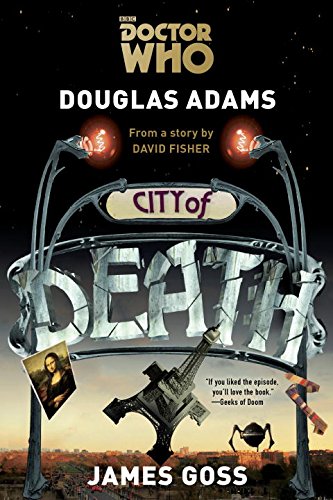
City of Death by: James Goss


City of Death was written by James Goss, based on the television story of the same name by Douglas Adams from an idea by David Fisher.  It was the 166th story to be novelized by BBC Books.


In adapting a television story to a full-length novel for BBC Books, authors have a variety of options.  James Goss took the time to do more than just transcribing the dialogue and actions of the television story City of Death which would have left the novelization quite short, especially as the story builds on the location footage of Paris being used without much dialogue as there is an extended chase sequence back to the TARDIS.  The way this is adapted is the pinnacle of Goss’s style and flair for making something visual translate to prose, by adding in several interludes with the characters who appear for only one scene: the artist who paints Romana, the tour guide at the Louvre, and the patrons played by John Cleese and Eleanor Bron all get to have small interludes which weave their way throughout the novel.  This even begins in the added prologue where Goss adds backstory between the opening scenes of the story on Hermann, Duggan, and the Countess with a small lead in for the Doctor in the TARDIS which are all things that didn’t need to be there yet they add so much character and flair to separate itself from the television story.  The advantage is being taken of making Paris feel like the City of Death as it’s essentially a character on its own, the city is alive and has a life of its own with active areas at night next to areas that are dead.


The one element of the plot added to increase the comic absurdity inherent in Adams’ script was the fact that Scaroth didn’t realize he was an alien until the end of episode one cliffhanger, something on television that only is there because that’s what Doctor Who does.  This isn’t a bad thing, but when writing it Goss had already committed to getting inside the character’s head, so he couldn’t just have the Count rip his face off for no reason.  He is explored by Goss as someone who has been attempting to act human but never realizing that he is not human so the uncanny valley of the character.  The idea is that he is an art collector who is doing the whole Mona Lisa heist to ensure that the funding for his time travel experiments can continue, something that gets the Doctor and Romana involved.  While they succeed as they do on television, a minor change is making it explicit that Romana being brought in to help on the time travel experiments so the plans can be brought forward.  There is also a lot more explicit disconnect between the Count and Kerensky, who here is shown to die from his perspective where the book takes a turn into black comedy for three pages before going back to the normal tone.  There’s also this weird moment added where the Doctor implies that Kerensky’s work will actually be remembered, but that might be another Kerensky which is just another aspect of humor injected into the story.


Goss should also be praised for not attempting to make City of Death the same length as Gareth Roberts’ novelization of Shada.  As this is an adaptation of a four part story, it doesn’t need to be over four hundred pages, yet still clocks in at around three hundred pages.  This doesn’t actually bring the story down at all as Goss’s prose grabs the reader from the first page and doesn’t let go.  There isn’t an attempt to imitate Douglas Adams’ style as Roberts’ homaging tendencies.  The famous lines are all there, but Goss allows City of Death to have his own mark on the story without changing any of the events.  Goss isn’t trying to improve anything as the story is already thought of as one of Doctor Who’s best stories anyway, indeed it is the story with the most viewers on broadcast (partially due to other channels being off air at the time). It makes the novelization work and perhaps be the perfect tribute to the story and the original author even if it had more time to be written than the original televised story.  10/10.

Doctor Who and the Creature from the Pit by: David Fisher


Doctor Who and the Creature from the Pit was written by David Fisher, based on his television story The Creature from the Pit.  It was the 63rd story to be novelized by Target Books.


The Creature from the Pit is not a good story on television.  The first produced for Season 17 there were several production problems, enough to stop Christopher Barry from ever working on the show again.  Lalla Ward famously hated her costume and the fact she was written for Mary Tamm’s Romana and the creature itself is phallic.  David Fisher is an author who has a hand at improving his scripts when novelizing them as evident in Doctor Who and the Leisure Hive, so there was a chance Doctor Who and the Creature from the Pit could have fared well, and in some aspects it does.  The novelization is very much a punchy adventure where a lot of the televised story ends up dragging as Fisher’s style of writing is very comedic which fits the types of stories he wrote and this era of the show.  It’s also very short, the paperback only coming in at 121 pages, so there isn’t much time to be wasted.  There is tightening of the adaptation of Part Four which is where the televised story ran out of any real steam into just two chapters, though one of those chapters feels quite long.  There’s also some inner life of characters revealed that we’re missing on television allowing for more humor to be added into proceedings.


So, if there are a lot of improvements, why doesn’t Doctor Who and the Creature from the Pit manage to stick the landing and turn a bad story good?  Well, mainly because the premise behind the story doesn’t actually have a whole lot going for it.  The plot is all about an ambassador being captured for years and eventually being saved by the Doctor while a planet’s evil ruler is overturned.  While this is a story which has been done before in other stories, here the setting and characters could have made everything work, but it feels like Fisher’s plot just goes through the motions of a Doctor Who story.  It’s also apparent that even in the novelization Romana’s part is meant for Mary Tamm and K9 somehow has even less to do with the plot here despite having quite a large part on television.  The creature doesn’t feel like its own character and there’s even a loss of the camp appeal of some of the performances which helped.


Overall, Doctor Who and the Creature from the Pit manages to improve on some things while other things get lost in translation from screen to page.  While David Fisher has a fun writing style, the story at the heart of the novel isn’t one with a whole lot of merit and ends up leaving the reader feeling kind of empty with how ‘meh’ it turns out to be.  The audiobook has the advantage of being read by Tom Baker, but even that doesn’t help matters too much.  5/10.

Monday, May 9, 2022

The Rescue by: Ian Marter


The Rescue was written by Ian Marter, based on the television story of the same name by David Whitaker.  It was the 127th story to be novelized by Target Books.


The fact that several First and Second Doctor serials weren’t adapted until the 1980s means that when they were adapted, some of the stories were approaching 20 years from original airing and generally repeat viewings hadn’t happened.  There was also a high chance that the archive was missing these serials so authors may not have had visual references for drawing the story.  The Rescue is one such novel where while the archival status was there, author Ian Marter was tasked with adapting a two episode serial in a full-length Target novel.  The Rescue on television is a story that works because it is simple: the Doctor and company land on a planet where an orphaned girl is terrorized by an alien, there’s a twist, the Doctor saves the day and the orphan joins the TARDIS in its travels.  That isn’t actually a lot and writer David Whitaker knew it, it served its purpose and entertained for less than an hour, not overstaying its welcome.  This mean that Ian Marter had to ensure that the novelization doesn’t overstay its welcome and somehow he managed to do that while expanding things to work as a full length novel.


In becoming a full-length novel, The Rescue easily could have diverged from the television story with rearranging of events to drag things out, but Marter doesn’t do that.  Instead of stretching events, new events of the novel are inserted in the narrative in a way that reflects a lot of the ways the world had changed from 1965’s original airing.  Much of David Whitaker’s dialogue remains in tact, but here there is almost more of it just to ensure that the Doctor, Ian, Barbara, and newcomer Vicki are all given some time to shine.  The climax on television is just the Doctor facing off against Bennett and then escaping with Ian, Barbara, and Vicki in tow, while in the novel Ian, Barbara, and Vicki have their own plot trying to find the Doctor in parallel.  The Doctor is also less of an action hero in the novel, with Bennett physically overpowering him, but the Doctor’s cunning gets to the bottom of why Bennett would murder the crew but not just kill Vicki.  The sequences in the caves really create a bond between the three companions that wasn’t quite there in the original version, especially after Barbara kills Sandy the Sand Beast and Vicki forgives her after a quick conversation.  While that happens in the novel, there is an undercurrent of tension which resolves when they are in the caves together and it lifts completely when Vicki joins the TARDIS.


Marter also does a brilliant trick in adding in extra worldbuilding about the futuristic setting, the planet Dido, and the people of Dido.  The actual rescue ship have scenes which essentially bookend the novel, creating characters that are all complete Marter originals.  They are essentially the 1980s idea of what an astronaut will be, with added patronization to the child Vicki, and condescension to the new member of the team which ends up being a lot of fun.  There’s even a point where the TARDIS nearly crashes the ship and the novel ends with a report on the mysterious findings of wreckage and death on Dido.  The people of Dido also don’t just appear right at the end of the story, but interact with the character much earlier, even if they are just observers.  There is also an added danger of the planet entering a cycle that already kills off most of the population which rebuilds itself once the planet reaches a certain position in the galaxy.  It’s why life evolved the way it did and while there isn’t really a scientific basis, it’s still a lot of fun for Marter to explore.


Overall, The Rescue adapts a little story perfectly into a novelization that expands a story without dragging it down in minutia.  The characters are given more focus and the small cast allows so much insight into what makes them work and takes some of the lacking elements of the serial and brings them into an almost modernization.  10//10.

Friday, May 6, 2022

The Dragon Reborn by: Robert Jordan: Solving the Mat Problem, Part 1 (Chapter 19 to 20)


[Mat] drew his sword, raised it high.  “Forward the Heart Guard!” He dug his heels in, and his mount leaped down the slope.  Behind him, hooves thundered in the charge.  “Forward!” He was the first to strike into the Trollocs, his sword rising and falling, his bannerman close behind.  “For the honor of the Red Eagle!”  The Heart Guard pounded into the gas between the spearmen, smashing the tide, hurling it back.  “The Red Eagle!”  Half-human faces snarled at him, oddly curved swords sought him, but he cut his way ever deeper.  Win or die.  “Manetheren!”  Mat’s hand trembled as he raised it to his forehead.  “Los Valdor Cuebiyari,” he muttered.  He was almost sure he knew what it meant—“Forward the Heart Guard,” or maybe “The Heart Guard will advance” –-but that could not be.  Moiraine had told him a few words of the Old Tongue, nd those were all he knew of it.  The rest might as well be magpie chatter.” – The Dragon Reborn, p. 216-217.


Sometimes when writing The Wheel of Time, Robert Jordan would switch perspectives far too quickly once the point of view characters expanded.  This is one of those times, as The Dragon Reborn has finally gotten to the point where Mat Cauthon can enter the narrative, but only covering two short chapters before going back to the girls.  There easily could have been a third chapter from Mat’s perspective here to even things out, but that chapter will come later and won’t be discussed until later with two other Egwene chapters.  These chapters may be brief, but there is a lot done here to make Mat work as a character and begin his ascent to actually being a functional character.  It cannot be understated that the fact that he hasn’t yet had a point of view chapter in The Eye of the World or The Great Hunt meant that we only got perspective from how others view him, and while he had character, it was static and brought down because of the curse of the dagger.  Now the dagger’s curse may not fully be gone, it is revealed that Siuan intends to keep him in the Tower as he still might need more Healing, but now that it is effectively gone and we get something in his head we know what he can think.  He works through his surroundings and comes to the proper conclusion that he is in the White Tower, the lair of the Aes Sedai, and while eating food left for him.  They talk circles around him when Siuan visits as he already has it in his head that they want to use him, planted by Lanfear who finds her way to his room first, describing him as being pulled by the Aes Sedai and herself as not one of the pitiful Darkfriends, only loyal to one, heavily implied to be Rand.


It is interesting that Lanfear has her own agenda, giving the reader the first real glimpse that the Forsaken do not have cohesion between them.  Lanfear is a rogue element trying to push another rogue element to her own ends.  Mat has essentially become a rogue element, being motivated by not being manipulated by others and carving a path for himself.  He immediately tries to leave, and while he is stopped he is still determined to find a way out, somehow.  This drive and independence creates the start of a character enhanced by what the Healing has done to him.  While it is not explained here, the quote at the beginning of this essay comes from the vision Mat has as he is waking, all in the Old Tongue translated into English, visions of fighting in the Trolloc Wars, something that he remembers fighting in despite not being alive when those wars happened.  He has a keener sense of things and immediately goes to the idea that this is all madness and he will have nothing to do with Aes Sedai, learning that his father and Tam al’Thor came to the Tower after them.  He is pushing himself away to his own ends, those ends just getting out of the Tower as fast as possible, possibly just heading home.  Now the Pattern will not have it, he has already blown the Horn of Valere and even he knows that it shouldn’t fall into the hands of the Dark One, but he has a purpose and a goal.  The Mat Problem stemmed from being passive, and now he can no longer be passive.  It’s not solved, but it is being worked on.

Wednesday, May 4, 2022

Shada by: Gareth Roberts


Just a quick disclaimer about this review before I begin.  Trans rights are human rights and those who disagree are definitively on the wrong side of history.  Gareth Roberts has made his transphobia clear through numerous Twitter posts and reviewing his work will always have that mark of transphobia on it.


Shada was written by Gareth Roberts, based on the television story of the same name by Douglas Adams.  It was the 165th story to be novelized by BBC Books.


There doesn’t seem to be another Doctor Who story that has as many options to experience as Shada.  Left incomplete in 1980 due to industrial action, it was originally meant to close the seventeenth season of the show, ending instead on the lackluster The Horns of Nimon.  This was meant to be Douglas Adams’ magnum opus on the show as he would leave the script editor position of the show giving way for Christopher H. Bidmead while producer Graham Williams would be giving the job to John Nathan-Turner.  Footage would be used in The Five Doctors, there would be a VHS release, an audio version, no less than three official and one unofficial animated version, and today’s version, the novelization published in 2012 just in time for the 50th Anniversary of the show under the pen of Gareth Roberts who won acclaim for his trilogy of Season 17 novels The Romance of Crime, The English Way of Death, and The Well-Mannered War.  Roberts does far more than attempt to simply emulate Adams’ style and copy the script word for word, at this point there was already the VHS release, audio, and an official and unofficial animation.  Shada was a story that people knew, and Roberts knew that a simple Target style novelization wouldn’t make it worth it.  The Target novelizations mainly were motivated by the fact that you couldn’t just watch a story, and even Shada, the unfinished story, had a DVD release approaching remastering the VHS release.  The book clocks in at 400 pages and expands every element of the story with Roberts crafting intricate motivations and backstories for all of the major players and quite a few of the bit parts, something that makes this feel not like a simple novelization, but a full novel.


The novel is presented in six parts because the television serial would have been six parts, but the six parts aren’t as evenly spaced as six 25 minute episodes, some are longer, some shorter, all given just enough time to explore the plot points they need to explore.  This isn’t perfectly done, there is a point where Skagra has just arrived on Earth and he is propositioned by this closeted gay man which just feels really off, playing on some very negative stereotypes about LGBT people in general.  Luckily, it is a small moment and serves more to get into what makes Skagra work as a villain, as he is a villain that only works through the performance of Christopher Neame or Andrew Sachs (depending on the version).  Here Roberts excels at making him feel off but not so off that the reader doesn’t understand what his motivations are and what makes him tick.  They are absolutely absurd motivations, but these motivations are distinct from the first page and there is more depth in the explanation of the opening scenes as well as a lot of the climax than any of the other versions of the story simply because this is a book.  It’s a book that makes brilliant use of its prose while homaging Douglas Adams’ very distinct style of writing, which amps some of the absurdism up to the highest level.


Overall, Shada is a novelization that injects as much character that can be through expansion of the rather simple story in tribute to the era that it was written in.  While it is a story that has been superseded by other releases, it is still a really good time and easily readable.  The characters jump off the page and the pace moves along rather quickly with the extended page count working really well although there are some genuinely poor tropes added in that weren’t in the original script and a few moments that just don’t work and indicate some of the views of the adapter rather than Adams.  9/10.

Monday, May 2, 2022

The Dragon Reborn by: Robert Jordan: An Examination of Wordplay (Chapters 16 to 18)


““Enough,” Nynaeve said.  Galad and Gawyn opened their mouths.  She raised her voice.  “I said enough!”  She glared at them until it was clear their silence would hold, then went on.  “Elayne owes the two of you nothing.  Since she chooses to tell you nothing, that is that.  Now, this is my room, not the common room of an inn, and I want you out of it…I doubt you asked permission to enter the Accepted’s quarters.”” – The Dragon Reborn, p. 195.


While these essays have been slowing down due to real life creeping its way in, it has given me some time to think about some of the aspects of The Wheel of Time that I have been neglecting.  This is mainly in the side characters, and this section of chapters is perhaps the perfect time to discuss three in particular.  First, these three chapters are all buildup to the healing of Mat Cauthon, the final chapter ending with the Healing which I will be discussing at the end of this essay as it ties in to the theme of wordplay.  The above quote is an integral example of how Nynaeve uses wordplay to her advantage, outright lying to Galad and Gawyn who have come to press Elayne on why she ran away.  This works, and exemplifies something incredibly important for both Gawyn and Galad’s character.  He is a follower of codes, his own especially.  Nynaeve has already ascended to the position of Accepted, something that is above the boys and Gawyn and Galad both, Nynaeve’s words stop them from pestering Elayne and they exit with the threat of the Aes Sedai above Nynaeve being informed about the trespass.  Yes, it is a lie, but they leave none the less.  This is something which should have a pin put in it as Galad and Gawyn will be reappearing throughout The Dragon Reborn, becoming both important players in the rest of the series from this point forward, especially as we expand to other perspectives beginning with this book and expanding in The Shadow Rising.  The wordplay is something Egwene, Elayne, and Nynaeve are afraid is already being weaponized against them.  Mat is preoccupying them and they have been told: “Verin said the Amyrlin would ‘see to him’” – The Dragon Reborn, p. 199.  It is emphasized throughout Chapter 16 and 17 that this is not the same thing as healing him.  Yes, there is the counter argument that is brought up, but Nynaeve, who’s perspective is not the one we are in but the one we are reacting through due Egwene’s point of view, weasels its way into Egwene’s mind.


The girls are only further given fear for Mat and their own future by Elaida, reentering the plot at this point as a major player, approaching them because she is already out to get Rand.  ““An interesting young man.”  Elaida studied them as she spoke.  “I met him only once, but I found him – most interesting.  I believe he must be ta’veren.  Yes.  The answers to many questions may rest in him.  This Emond’s Field of yours must be an unusual place to produce the two of you.  And Rand al’Thor.”” – The Dragon Reborn, p. 204.  Note exactly what she is saying, and what exactly the yes may mean.  She doesn’t let slip if she knows that Rand is the Dragon Reborn, the girls are only saved by being told by the Amyrlin not to actually say anything, something that Sheriam saves them, Sheriam being at least trusted by Siuan.  Elaida is a woman who clearly has a plan of her own and is only letting out very small snippets of what that plan might be.  It is completely planned to the word of what Elaida is saying, yet Jordan is leading Egwene and the reader to believe she doesn’t actually have what is going on down.  She may not even know of the Black Ajah and if she does she may not believe it is a real group of Aes Sedai.  It is also important to note that once Elaida leaves Sheriam berates the girls for letting Elayne in on the knowledge of the Gray Man, simply by mentioning it to see how Elayne reacts.  It is the lack of a reaction that tips her off and reveals there are only seven people who know of the Gray Man being in the Tower.


The section ends with Egwene, Nynaeve, and Elayne viewing the healing of Mat where words become very important.  Mainly, that Mat speaks in the Old Tongue, the language of Manetheren, a language he should not know.  While there are battle cries of Manetheren, it is the final phrase, screamed as the attempted Healing ends which is important “Mia ayende, Aes Sedai! Caballein misaim ye! Inde muagdhe Aes Sedai misaim ye! Mia ayende!” – The Dragon Reborn, p. 212.  It is a phrase Egwene does not recognize but is revealed to be a revocation of being a piece of meat for the Aes Sedai, something that had been echoed by Rand for the last two books, but something we haven’t seen from Mat.  This is important as we haven’t actually seen enough of Mat’s point of view yet.  There is the fear that the Healing has not worked, Mat is returned to his room and the girls taken away to their punishment of scrubbing pots.  This is how everything of this section ends, with the uncertainty, all because words cannot be used to confirm if Mat has been Healed.

Sunday, May 1, 2022

Once Upon a Time-Lord by: Steve Parkhouse with art by: John Ridgway and letters by: Annie Halfacree


Once Upon a Time-Lord is written by Steve Parkhouse with art by John Ridgway and lettering by Annie Halfacree.  It was released in Doctor Who Magazine issues 98-99 (February – March  1985) and is reprinted in its original form in Doctor Who: Voyager by Panini Books.


So here we are.  The end of Steve Parkhouse’s run of Doctor Who comics.  This is the big one, the one that ends everything that Parkhouse has been building towards over his five year run on the strip.  After this point while there would be a year or so where Alan McKenzie took over as writer, there would be a general shift to avoiding a single writer on the strip which is where you get contributions from people who would become big names in modern comics, such as Grant Morrison, Dan Abnett, Richard Starkings, and to a lesser extent Jamie Delano.  John Ridgway would stay on the strip consistently providing art (though eventually going down to only pencils) well into the 1990s, though not always being the singular artist with several breaks.  Once Upon a Time-Lord is an ending and despite being only two installments long, it feels like it deserves its ending status.  Parkhouse’s ideas just play up the fact that this is a comic book allowing Ridgway the freedom to play around with page layouts and characters, slipping in so much more in these two issues that a standard Doctor Who comic story could ever hope to do.  The setting is essentially a land of make believe with several references to classic fairy tales, adventure stories, and even pop culture like The Lord of the Rings and Star Wars.  Some of these have serial numbers carefully filed off, though not so much that you can’t tell just what it’s supposed to be referencing, and these are just quick references.  They add to the atmosphere and ideas that are being played with.


Ultimately, Once Upon a Time-Lord is a story all about the Doctor defeating a foe that is bigger then him not by something like on television with a strong arm, but with cunning.  The cunning of the Sixth Doctor is something that really comes out here as he immediately searches out Frobisher, the friend he has made and getting Astrolabus to destroy himself.  The story ends with almost a puff of hot air which is kind of poetic and not nearly as much of a let down as it could have been.  This is one of those foes that being beaten by a deus ex machina is actually quite fitting since Astrolabus is a god level threat, something that was done quite a bit in the classic series but at this point is kind of something that being used in expanded universe to much greater effect.  This is a story where we move away from a comic style at points, like where Frobisher is presented with and eats a worm (yes that’s from this issue) and it’s one of those pieces of absurdity that make it worth it.  Astrolabus is also just a really good villain, essentially being driven by this madness, the madness that would bring the man into this legendary status that he just sort of feeds on and starving him of that legend is what ends everything.  It’s implied he is on his last regeneration, but that may also just be a red herring as Parkhosue has been playing with the idea of a legend which is disturbingly depicted by Ridgway.


Overall, Once Upon a Time-Lord is a near perfect final installment for this era of Doctor Who Magazine comics and is the story on the precipice of change with the writer leaving after this.  Hats off to Steve Parkhouse for bringing the strip to a consistent quality from the very beginning and building several arcs to satisfying conclusions.  Parkhosue was unashamed of being a comic strip and going to whacky places that the television show would be unable to while the art always works in tandem with the ideas to bring something brilliant.  9/10.